Water is the whole ballgame in this soil
Houston Black clay doesn't just get wet — it changes size. Saturated clay swells and pushes; dried clay shrinks and drops whatever it supported. A foundation with wet soil on one side and drought-dry soil on the other is being actively twisted, season after season. Every pier job in the county has a drainage story behind it: the downspout that dumped at a corner for a decade, the flowerbed graded toward the house, the slope that sends the neighbor's runoff under the slab.
The fixes, cheapest first
Gutters and downspout extensions ($300–$1,500). Rule one: roof water leaves the building. Extensions should discharge 5+ feet from the slab, onto ground sloping away. Half of Taylor's drainage problems end here.
Regrading and surface swales ($800–$3,000). Soil should fall at least 6 inches over the first 10 feet from your foundation. Decades of mulch, settling backfill, and landscaping quietly reverse that; a crew with a skid steer restores it in a day or two.
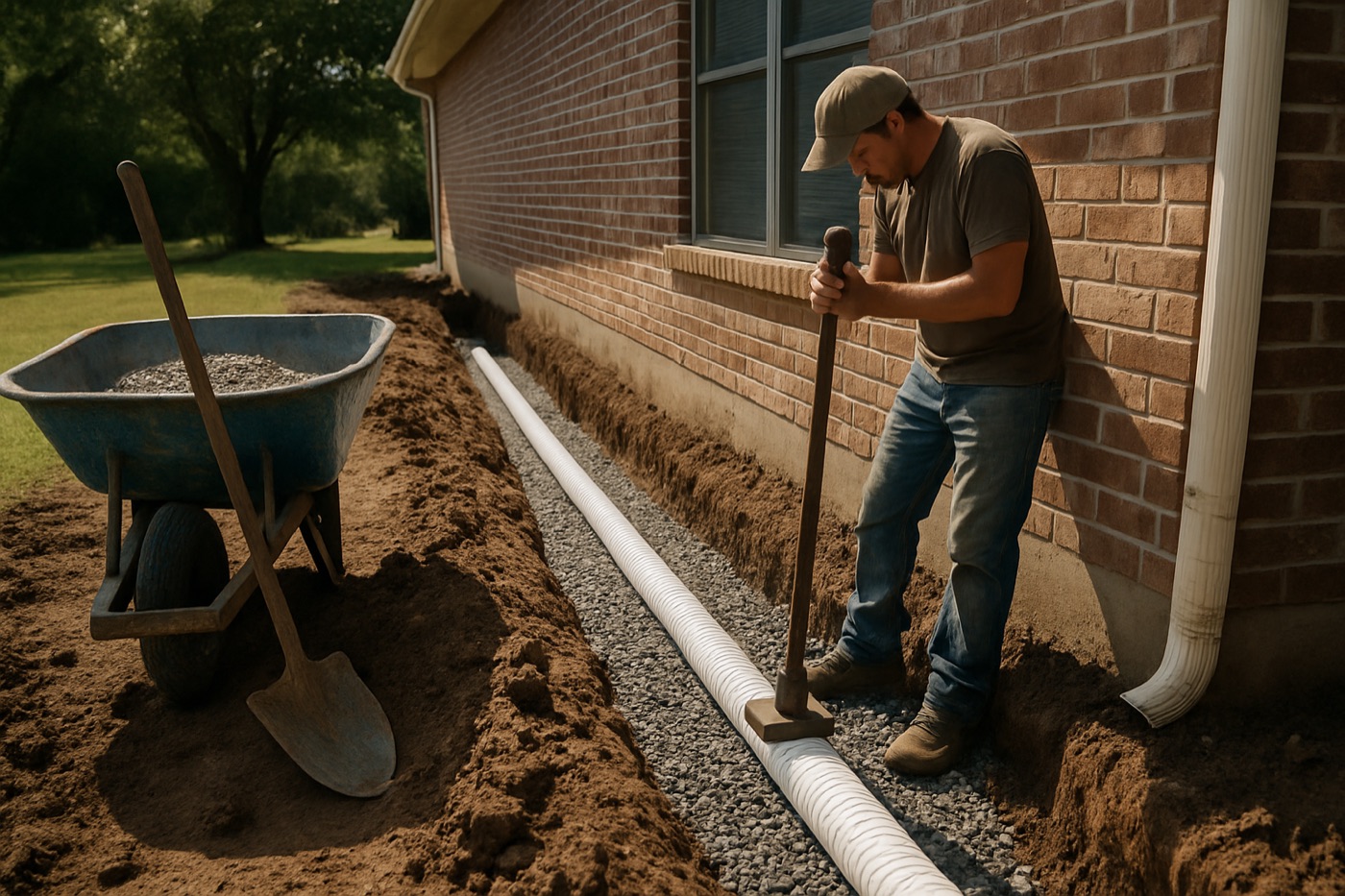
French drains ($1,500–$5,500). Where surface fixes can't win — pooling against the slab, water moving between houses on tight new-subdivision lots, chronic crawl-space moisture — a gravel-and-pipe drain collects subsurface water and carries it to daylight. Depth, length, and discharge planning separate the drains that work for 20 years from the ones that clog in three.
Soaker-hose watering (nearly free). The flip side of drainage in clay country: in drought, soil pulling away from the slab needs moisture replaced evenly. Hoses 12–18 inches from the foundation, run mornings during dry spells, keep the clay from dropping your slab edge. Prevention both directions — that's life on blackland.
Drainage first, piers second
An honest evaluator checks drainage before quoting piers, because piering a foundation while leaving the water problem guarantees a callback. If a company quotes you a pier job without walking the lot in the rain (or at least asking where water goes), get a second opinion — you may need $2,000 of drainage, not $8,000 of piers.
Common questions
How do I know if my drainage is causing foundation problems?
Walk the house during a hard rain: pooling within a few feet of the slab, downspouts discharging at corners, or soil sloping toward the house are the signatures. Inside, seasonal door-sticking on the wet side of the house is the classic confirmation.
Do French drains really work in clay?
Yes, when built for clay: proper depth, filter fabric to slow silting, adequate fall, and a real discharge point. In heavy clay the drain intercepts water that can't percolate away — that's precisely the situation that needs one.
What slope should my yard have at the foundation?
Six inches of fall across the first ten feet is the standard target. Where lot lines make that impossible — common in Taylor's newer, tighter subdivisions — swales and drains make up the difference.
Can I do drainage work myself?
Downspout extensions and soaker hoses, absolutely. Regrading and French drains are worth pricing professionally — the machine work is fast, and getting fall and discharge wrong just moves the water problem somewhere worse.
Get a free foundation assessment
Describe what you're seeing. A foundation specialist will call you back to schedule a free evaluation — usually the same day.
Got it — expect a call back shortly to set up your free evaluation.